
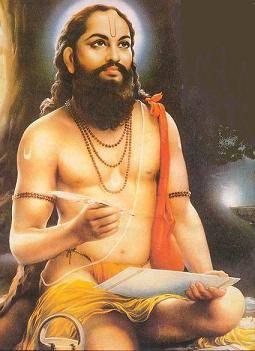
Bhagwan SriKrishna had given a promise that he would take rebirth (reappear) when there would be religious-darkness. He also promised that he would again lay the foundation of Dharma through Karma, Knowledge, Upasana and Vedas.
As if, to fulfill this promise, a boy named Narayana was born on Chaitra-Shuddha 9 Shake 1530 that is in 1608 AD.
It was an auspicious day of Ramnavmi. Suryajipant and Ranubai were his parents. They were living in the village Jamb. His parents were the sincere worshipers of ‘Surya’ and ‘Rama’. Narayana always told his parents that he was deeply engaged in thinking of the welfare of the whole world. He expressed his desire to obtain his elder brother Gangadgar’s blessings. Gangadhar tried to convince him that Narayana was still very young to bear the ‘Anugraha’ but this made Narayana very unhappy.
At last unhappy Narayana went to temple ‘Maruti’ where, in the midnight he could see the God, real God. Narayana insisted upon the ‘Anugraha’. At the same time he could see “ Prabhu Ramachandra ” who blessed him and named him as “ Ramadas “ and advised him to lay the foundation of Dharma.
Narayan’s father, Suryajipant, was no more and his mother often asked him to get married immediately. She also asked him not to say no till the Antarpat was held. Narayana accepted his mother’s suggestion. He obeyed her and placed himself on the marriage vedi. But when the holy rhymes were sung and as soon as he heard the word ‘Sawadhan’, thinking that he had fulfilled the promise given to his mother he ran away from the place. He was just 12 years old at this time. It was not an easy and ordinary thing to dedicate one’s own life for the betterment and welfare of the world.
Ran-off from his native place, Narayana came straight to ‘Panchwati at Nasik’. He visited Lord Rama’s temple there and reached ‘Takali’, where he lived from 1620 to 1632. Here he spent his life in ‘Gayatri - Purashcharan’ and completed 13 cores Ramnama recital.
During the 12 years he spent all his time in meditation. He went from house to house and asked ‘Madhukari’ for his meals. Along with meditation he did exercises ‘Suryanamaskar’. He could see the God Rama and Marutiraya with his own eyes. He was advised to undertake the work of welfare of the world by doing Upasana and establishing Dharma. He started his valuable work of Dharmodhar, Janodhar and Rashtrodhar from this time.
As per God Rama’s advice he travelled through the whole India from 1632 to 1644.
While travailing , he came into contact with different people of different caste and creed. He could learn exact about the public and social conditions. At that time the rulers were very cruel and unjust, who tried to demolish and destroyed Hindu-temples. The ignorant and poor Hindu ladies were raped and misused and spoiled. There was nothing but darkness. People had to face all such cruelty helplessly.
They were so poor and weak that they were quite unable to raise their heads and hands to protest it. Sri Samartha had closely observed it and decided to increase their physical power by way of unity and also the importance of trust on Prabhu-Ramchandra.He tried his best to enlighten their lives.
While bringing these reforms he asked people that God is part and parcel of their lives.
He visited hundreds of holy places like Kashi, Gokul, Mathura, Vrindavan, Dwarka, Shrijagnnath, Shrirameshwar, Lanka Gokarn-Mahableshwar, Karveer, Dakshin-Kashi, Shri-Parashuram etc.
During his journey he setup nearly 1100 Maruti-temples.These are the centers where peoples comes together .He also appointed his devotees to look after these temples. This planning clears his foresight. Through Ramopasana and balopasana he wanted to build well-cultured and healthy society. It was his real dream.
After visiting various holy places he returned to his native place Jamb in the year 1644. He had an emotional meeting with his mother and brother. Then he again returned to Krishna valley.
At this time Chatrapati Shivaji Maharaj had started establishing his political power. He came to Masur but his camp was always in Dervan-valley, Waghapur-sada, Bhairavgad or valley of Kalamba.
Among all his Maruti idols, idols at Chaphal Shahapur, Masur Umbraj, Shirala, Pargaon, Majgaon, Bahe-Borgaon and Manpadale are very important. He also stared celebrating Ramnavami Festival at Masur. At the same time Prabhu-Rama gave him drishtant. Samartha found Rama’s and Mahishasur mardini’s idols in the deep pond of Angapur. He set up God Rama’s idol at Chaphal Samartha was bringing religious and national awareness while Chatrapati Shivaji Maharaj was trying to establish Hindu-swaraj.
Now fame of Samarth reached far and wide.Shivaji Maharaj was very keen to meet him. But unfortunately he could not see him at Masur. So he went back to Pratapgad. One day Shivaji Maharaja saw Samarth’s divine appearance in the night. When Shivaji Maharaja woke up in the morning he found a coconut which was given to him by Samartha as a token of blessings. So King Shivaji came to Mahuli to see Samartha . At the same time a disciple came from Samartha with a letter for King Shivaji.
Samarth had praised Shivaji Maharaj in this letter. King Shivaji in his reply letter expressed his strong desire to see Samarth. King Shivaji presented himself at Masur. When he heard that Samartha was at Shinganwadi, he went there. Here met the two great personalities of different fields, different aims and of different dreams, in 1649. This was their first meeting. Here Samartha gave him ‘Anugraha’. Here onwards their relations became closer, loving and respectful.
King Shivaji Maharaj requested Samartha to live at Rajgad, Pratapgad or on the fort of Parali. As per King King Shivaji’s request Samarth Ramdas came to Parali in 1676. From that time onwards the fort was recognized and known as ‘Sajjangad’.
Samartha set up the idol of goddess Mahishasurmardini at the eastern side of the Sajjangad which was found in the pond at Angapur and was named ‘Angai’ or ‘Anglai’. He also set up the idol of Maruti at the west to protect the Sajjangad and this ‘Maruti’ is known as ‘Dhabyacha Maruti’. While he was living on Sajjangad, Chatrapti Shivaji Maharaj left this world for ever. He left this world in 1680. Samartha became very sad. When he had gone to Tanjawar, he had in his mind to set up the idols of Shriram, Laxman and Seeta and Maruti there.
Sri Samartha asked Vyankoji Raje to find out a good artist. Vyankoji Raje found an artist who was blind. But Samartha took from him the idols. Magh Vadya 5, Shake 1603 that is in the year 1682 (English Year), the images were brought and were set up in his bed-room (Shejghar) and he himself worshipped them.
Samartha has written books on Philosophy & religion: it is seldom compared to ocean. ‘Samartha wrote Manacheslok’ which became more famous . Ramdas also wrote ‘Dasbodha’ which is equally valuable as the ‘Manacheslok.Samarthas literature clears the darkness of spirutual aspirants and has been source of inspirations to thousands.
Dasbodha’ took birth in the Shivtharghal, which has complete base of religious mindedness of Sri Samarth Ramdas Swami. One can carry out his human duties through reading, thinking of Dasbodha.
This clears the very valuable importance of ‘Dasbodha’. It is very useful not only to saints learned but also to common people. It can enlighten not only to ‘Mumukshu’, ‘Sadhaka’ and ‘Siddha’ but also to very very common people. It is just like a lighthouse in ‘Parmarth’, to wise men and ignorant, for ‘Viveka and Vairagya’, happiness and worries’.
It touches religious and social life, political and common life. After the departure of Chatrapati King Shivaji Maharaja he felt that he had nothing left undone in his life. So he left this world on Magh 9, Shake 1603 that is in the year 1682 (English Year) on the Sajjangad.


